Getting there, the hall and the horses
Winter Riding School visit
Getting to the Winter Riding School in the Hofburg, which entrance to use, what to wear, the hall's history and what you see and hear inside.
Check dates and availability ↗Quick answer
The school is inside the Hofburg at Michaelerplatz 1, and its own advice is to walk in via Michaelerplatz. Your ticket names which of three entrances to use. The hall is not heated or air-conditioned, there is no lift or cloakroom, and photography is banned. Children under 3 are not admitted. Your booking calendar and confirmation show the start time, so plan your day from those.
Where it is and how to get there
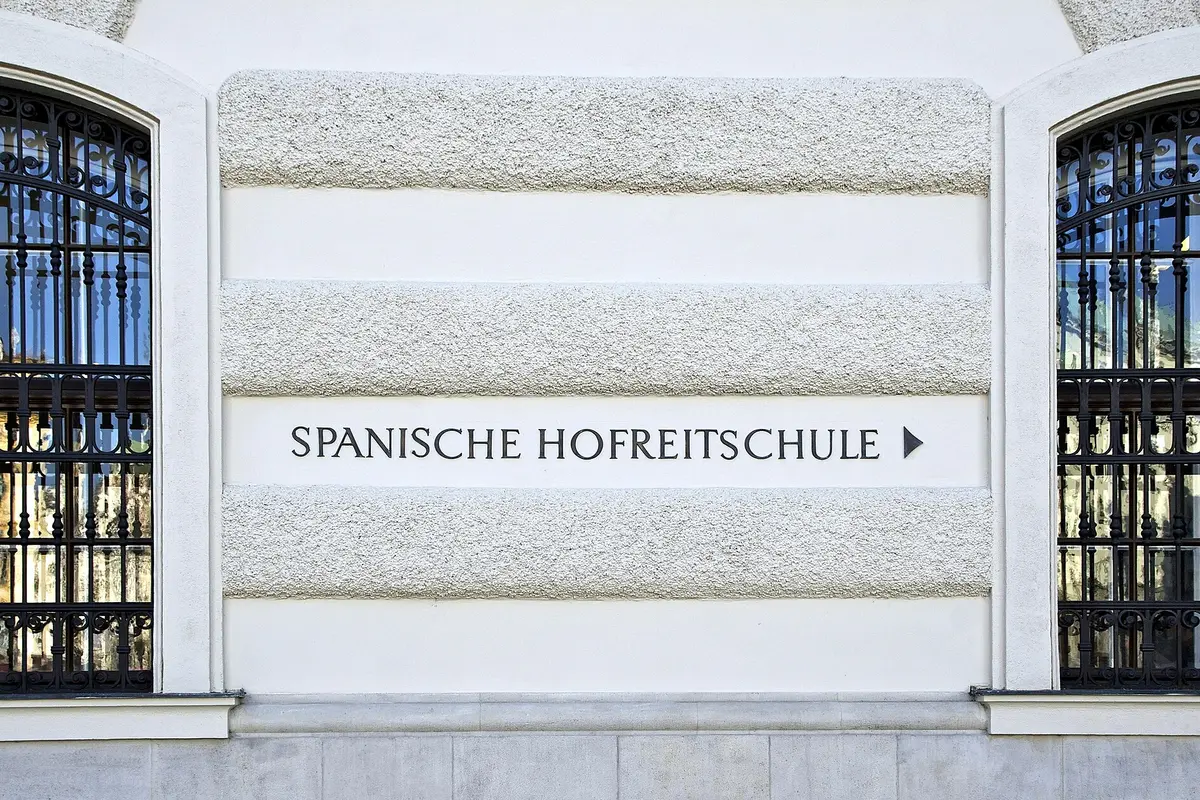
The Spanish Riding School is inside the Hofburg in central Vienna, between Michaelerplatz and Josefsplatz. The address is Michaelerplatz 1, where the Visitor Centre sits under the Michaelerkuppel dome. The school's own tip is to walk in via Michaelerplatz. For the metro it lists the U1 to Stephansplatz and the U3 to Herrengasse, plus tram and bus stops, all on its how-to-find-us page. Parking is limited, because the first district is a short-term parking zone. The school names the Freyung, Neuer Markt and Oper garages nearby.
Which entrance to use
Performances and Morning Exercise have three possible entrances: Michaelerkuppel, Reitschulgasse and Josefsplatz. Your ticket says which one is yours, so go straight there. If your ticket is a voucher from an outside booking site, swap it at the Visitor Centre desk first. Guided tours are different: you meet in the foyer of the Visitor Centre, and the guide collects you there, so arrive five minutes before the start. The Visitor Centre has a souvenir shop, and a small kiosk at the Josefsplatz entrance opens on performance days.
What you see and hear in the hall
Music runs through every performance: the riding is set to classical Viennese music. Riders wear brown tailcoats and bicorne hats. In the full programme Wikipedia describes, the young stallions that have just arrived from the Piber stud come first, then the High School movements, the pas de deux in mirror image, work in hand, a stallion on the long rein, the airs above the ground and the School Quadrille. The 45-minute short performance shows a selection, with live commentary between displays. Riders salute the portrait of Emperor Charles VI above the royal box before they ride.
How the hall came to be
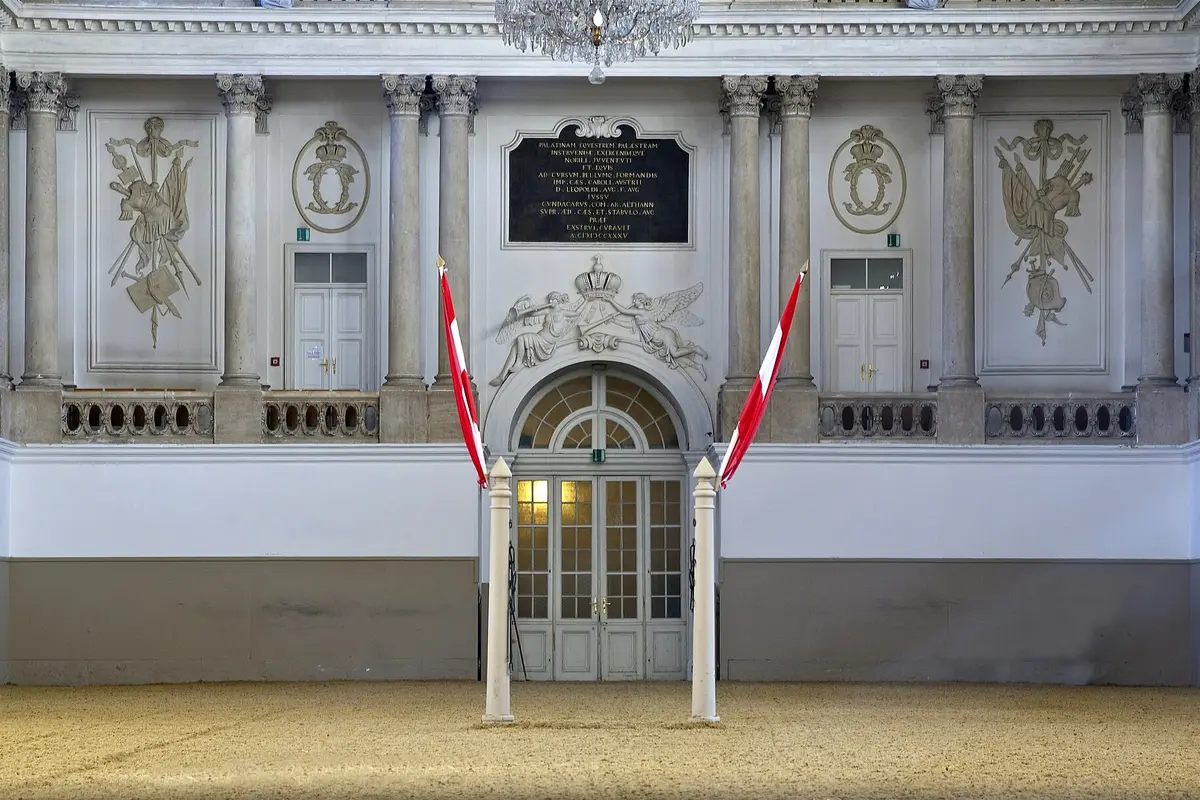
The Winter Riding School was built between 1729 and 1735 for Emperor Charles VI. Johann Bernhard Fischer von Erlach designed it, and his son Joseph Emanuel completed it. The Latin inscription over the riding entrance says it was built for training the young nobility and for training horses for dressage and war. The school calls it the most beautiful riding hall in the world and says it survives in its original form. Wikipedia gives its size as 55 by 18 metres. Under Empress Maria Theresia it also hosted carousels, masked balls and court balls, and in 1848 the first imperial diet of the monarchy met here.
A short history of the school
A riding ground at today's Josefsplatz is first mentioned in a document dated 20 September 1565, which the school treats as the first reference to what became the Spanish Riding School. The name comes from the Spanish horses that Ferdinand I, who grew up in Spain, brought to the court in Vienna. The school says that after the French Revolution and the Napoleonic Wars, Vienna was the only place where the High School of classical horsemanship continued without interruption. The school returned to the Hofburg in 1955, and its first performance there was on 26 October. Women were first accepted for rider training in 2008, and UNESCO listed the school's horsemanship as intangible heritage in 2015.
The horses: born dark, turned white
Lipizzaners are a breed developed in the Habsburg Empire in the sixteenth century. The name comes from Lipica, now in Slovenia, where Archduke Charles II founded a court stud in 1580. According to Wikipedia, foals are usually born bay or black and lighten each year, with the change complete between 6 and 10 years of age. So a young stallion at Morning Exercise may still be dark, while the fully trained stallions are white. The school has traditionally kept at least one bay stallion. Its horses now come from the Piber Federal Stud in Styria, and in 2022 UNESCO listed the knowledge of Lipizzan breeding.
Timing, seasons and the summer break
The school publishes a calendar for each event, and your booking calendar and confirmation show the start time, so this guide gives none. The stallions also don't stay in Vienna all year. Wikipedia reports that they spend July and August at the summer stables at Heldenberg in Lower Austria, where they are ridden out in the forest rather than schooled. The school's own Heldenberg page describes a rotation between Heldenberg and Vienna that puts the stallions there for roughly six months of the year. The two accounts differ in detail, so check the calendar for your dates before you plan around a show.
What to wear and bring
The hall can't be heated or cooled, so inside it is close to the temperature outside, and the school recommends a coat or jacket. No dress code appears in its visitor information. There is no cloakroom or luggage storage, so travel light, and strollers can't come into the hall. Dogs are not allowed; assistance dogs must be announced in advance. Photo, video and audio recording are banned, and on guided tours your guide says when and where photography is allowed. There is no public Wi-Fi. Visitors may not pet, feed or touch the horses.
How long it takes, and with children
The short performance lasts about 45 minutes. The school lists longer performances at about 70 and 90 minutes, and Morning Exercise at about an hour. Children under 3 are not admitted to any event. A shorter show is easier for young children, but standing places mean a full programme on your feet. The booking page doesn't name the language of the commentary, so ask the provider if that matters to you. The school's tours run in English, German and Spanish.
Accessibility
The school is in a listed building with no lift. The first gallery, the second gallery and the royal box are reached by stairs only, so they are not suitable for visitors with limited mobility. Wheelchair places are limited and can't be booked online. You email the school at [email protected], and the reservation is confirmed only when you receive written confirmation, which you show when you collect your ticket. Guided tours are accessible, except the architectural tour, which is for visitors who are fit and steady on their feet.
Who this isn't for
This visit isn't for you if you want to film or photograph the horses, if a lift is essential, or if you hope to ride or to pet a stallion. It isn't for children under 3, or for anyone who needs a cloakroom, since there is none. And if you only want the building without a show, the school's own tours cover the Winter Riding School, the Summer Riding School and the stables.
Frequently asked questions
Where is the Spanish Riding School?
Inside the Hofburg in central Vienna, between Michaelerplatz and Josefsplatz. The address is Michaelerplatz 1, and the Visitor Centre is under the Michaelerkuppel dome.
How do I get to the Spanish Riding School?
The school's own advice is to walk in via Michaelerplatz. By metro, it lists the U1 to Stephansplatz and the U3 to Herrengasse. Parking in the first district is limited.
Is the Winter Riding School heated?
No. The hall can be neither heated nor air-conditioned, so the temperature inside is close to the temperature outside. The school recommends bringing a coat or jacket.
Can children go to the Spanish Riding School?
From age 3. Children under 3 are not admitted to any event, and strollers can't come into the hall. Check what the booking calendar offers for children, because conditions differ by ticket.
Is the Spanish Riding School wheelchair accessible?
Only in part. There is no lift, and wheelchair places are limited and can't be booked online. Email [email protected] and wait for written confirmation. Guided tours are accessible, but not the architectural tour.
Are the horses in Vienna in summer?
Not always. Wikipedia reports the stallions go to Heldenberg for July and August, and the school describes a rotation that takes them there for roughly six months of the year. Check the calendar for your dates.
Sources